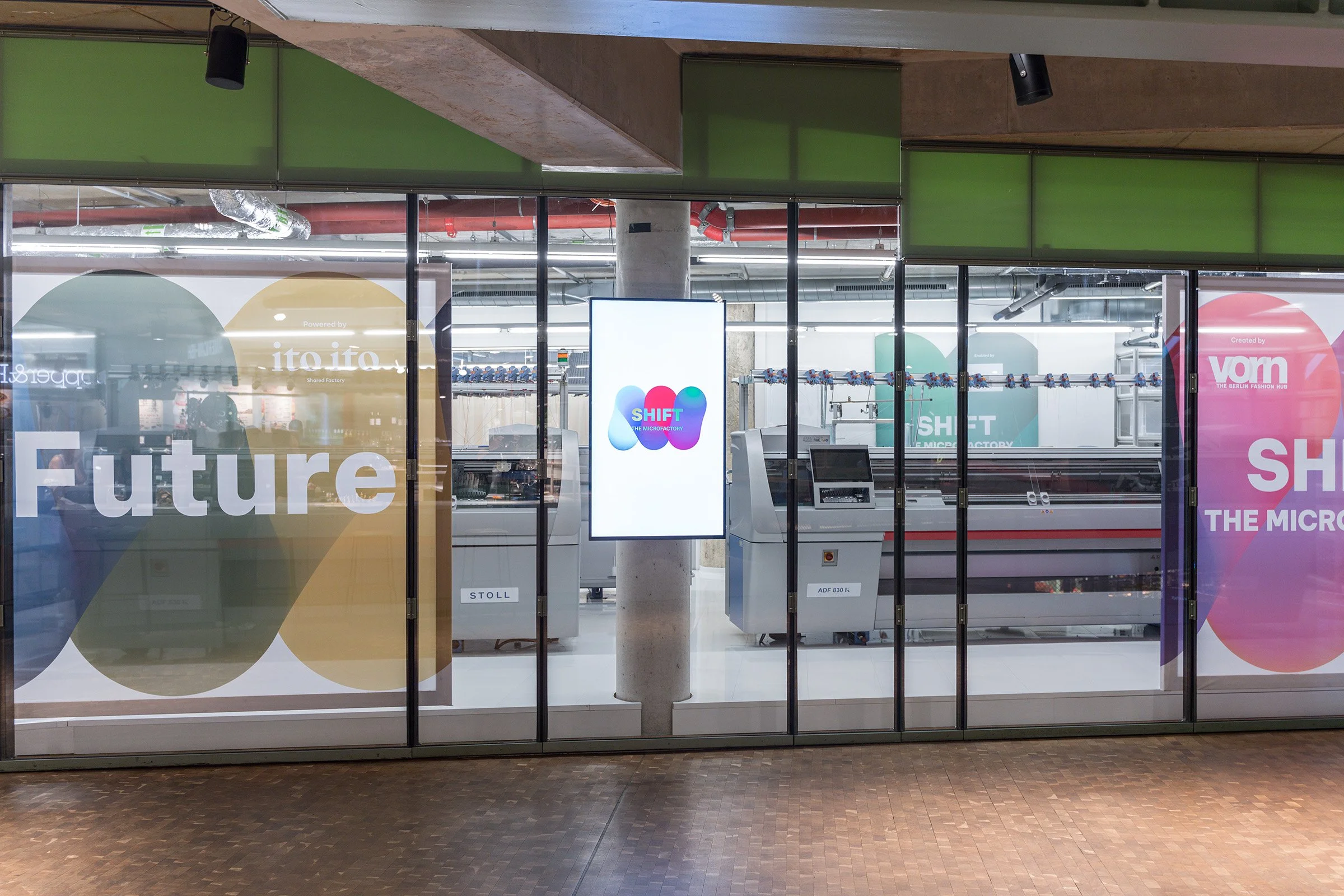
We don't just make fashion – we're actively shaping its future. Through collaborations with research institutions and our own development projects, we explore how digital production, microfactories, and circular design can transform the textile industry.
HOW TO DESIGN FOR CIRCULARITY
Over the past two years, with support from DBU Deutsche Bundesstiftung Umwelt, VORN — The Berlin Fashion Hub, BSP Business & Law School, and project partners have explored the implementation and operation of a circular microfactory. The project resulted in a practical guide for fashion designers to support sustainable product development and facilitate end-of-life disassembly of garments.

Leave your Name and Email to get the Circularity Design Guide:

RE.SPIN – CLOSING THE CIRCLE WITH KNITWEAR AUTOMATION
In the research project “Re.Spin” VORN eG – The Berlin Fashion Hub and ito ito GmbH are jointly developing the technological foundation for circular textile production. The goal is to transform the currently linear system of design, manufacturing, and disposal into a closed loop through the development of digital infrastructure and automated processes.
At the center is SHIFT – The Microfactory, a modular production system that combines automated recycling and knitting processes. Here, used textiles are mechanically separated, the fibers are processed into new yarns, and directly knitted back into garments – with minimal energy consumption and no loss of quality.
Re.Spin creates the digital foundation: A material database documents the properties and origin of materials used. Digital product passports enable transparent traceability. A design-to-production platform fully integrates the process from design to manufacturing digitally.
With this approach, Re.Spin establishes the platform infrastructure for locally anchored, demand-driven, and transparent production systems that make a decisive contribution to reducing textile waste, CO₂ emissions, and resource consumption.
The project is co-financed by the State of Berlin and the European Union as part of the Masterplan Industriestadt (Industrial City Masterplan).
Created by:


Funded by:



FEASIBILITY STUDY »MICROFACTORIES«
The fashion industry, a cornerstone within the global economic framework, is currently confronted with a constellation of intricate sustainability challenges that cast shadows on its ethical and sustainability standing. Chief among these challenges are the issues of overproduction, substantial textile waste, and perturbing levels of climate emissions.
You can find the whitepaper on the Website of VORN – The Berlin Fashion Hub.